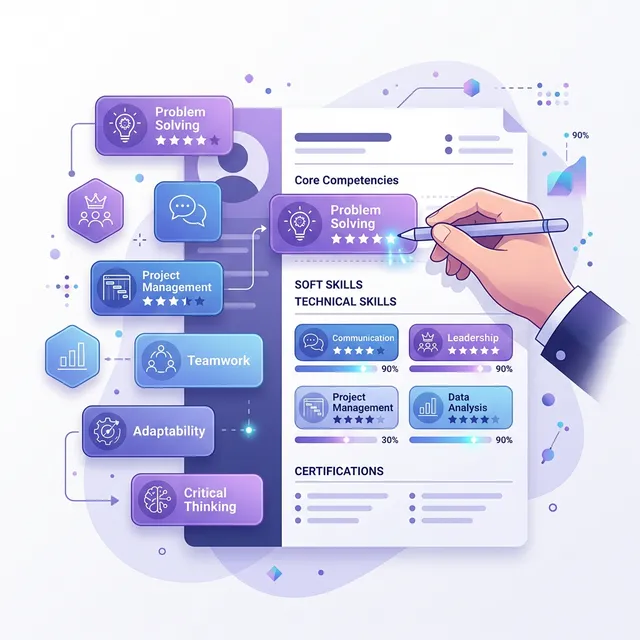
Skills sections get misused more than almost any other part of a CV. Either people list everything they have ever touched ("Microsoft Word, Excel, PowerPoint, the printer, a stapler") or they list nothing useful at all ("good communicator, team player, hard worker").
Neither works. Here's what does.
Hard Skills vs Soft Skills , Why You Need Both
Hard skills are the specific, teachable, testable abilities. Programming languages. Accounting software. Spoken languages. Certifications. These are what ATS systems scan for when they're matching your CV against a job description. Get these wrong and you never reach a human reader.
Soft skills are how you work. Communication. Leadership. Problem-solving. Adaptability. These are what the human reader cares about once the ATS has passed you through. But here's the catch: listing "good communicator" in a skills section does nothing. Soft skills only land when you demonstrate them in your experience section through actual examples.
So your skills section should be mostly hard skills, organized clearly. Your experience section should demonstrate the soft skills through what you actually did.
Skills That Are Dead (Stop Listing These)
Before we get to what works, let's clear out the noise.
Remove these immediately:
- Microsoft Word / PowerPoint / Outlook , Assumed for literally every office job. Listing these tells recruiters you are filling space.
- "Good communicator" , Every single person on earth claims this. It means nothing without an example.
- "Hard worker" / "Team player" / "Motivated" , These are what everyone writes when they can't think of anything specific. Cut them.
- Typing speed , Unless you are applying to be a stenographer, nobody cares.
- Basic internet research , This has been a universal human skill since approximately 2005.
Universal Skills That Still Work in 2026
These apply across industries and experience levels. Only list the ones you can back up with examples if asked.
- Data analysis , Turning numbers into decisions. Relevant in almost every field now.
- Project management , Planning, executing, delivering. Worth listing with the methodology (Agile, PRINCE2, etc.) if relevant.
- Stakeholder management , Managing expectations across teams and levels. Underrated on CVs.
- Process improvement , Finding inefficiency and fixing it. Every employer wants this.
- Cross-functional collaboration , Working across departments. More specific than "teamwork."
- Budget management , If you have managed any budget, say so with the size.
- People management , If you have managed others, state the team size.
- Written communication , Reports, proposals, documentation. More useful than the vague "communication."
In-Demand Skills by Industry (2026)
Technology and Software Engineering
Tech hiring has shifted. Two years ago everyone wanted React developers. Now the premium is on people who can work with AI tools and build systems that use them intelligently.
- Languages: Python, JavaScript/TypeScript, Go, Rust, SQL
- Frameworks: React, Next.js, Node.js, FastAPI, Django
- Cloud: AWS (specify certifications), Azure, Google Cloud Platform
- DevOps: Docker, Kubernetes, CI/CD pipelines, Terraform, GitHub Actions
- AI/ML (2026 premium): LLM integration, RAG systems, prompt engineering, vector databases
- Databases: PostgreSQL, MongoDB, Redis, Elasticsearch
- In demand right now: LLM API integration, AI tool evaluation, responsible AI practices
Tech tip: List proficiency levels. "Python (Advanced), JavaScript (Intermediate), Rust (Learning)" is more useful than just "Python, JavaScript, Rust." It sets expectations and shows self-awareness.
Data and Analytics
- Core tools: SQL (essential), Python (pandas, numpy), R
- Visualization: Tableau, Power BI, Looker, Metabase
- Cloud data: BigQuery, Snowflake, dbt, Spark
- Statistics: A/B testing, regression analysis, forecasting
- ML basics: scikit-learn, TensorFlow (for analyst-adjacent roles)
- In demand right now: dbt (data build tool), real-time analytics, AI-assisted insight generation
Marketing and Growth
- Paid channels: Google Ads, Meta Ads, LinkedIn Ads, TikTok Ads
- SEO: Technical SEO, content strategy, keyword research, Core Web Vitals
- Analytics: Google Analytics 4, Mixpanel, Amplitude, attribution modelling
- Email: Klaviyo, HubSpot, Mailchimp, lifecycle marketing
- CRM: Salesforce, HubSpot CRM, Pipedrive
- Creative tools: Figma (for briefs), Adobe Creative Suite, Canva Pro
- In demand right now: AI content tools (knowledge of what they can and can't do), first-party data strategy, GA4 proficiency
Finance and Accounting
- Core skills: Financial modelling, variance analysis, FP&A, budgeting, forecasting
- Software: Advanced Excel (VBA, Power Query), SAP, Oracle, Xero, QuickBooks, NetSuite
- Reporting: Power BI, Tableau (financial dashboards), management accounts
- Compliance: IFRS, GAAP, SOX compliance, internal controls
- Qualifications to list: ACA, ACCA, CIMA, CFA (and part-qualification stages)
- In demand right now: FP&A automation, ESG reporting, AI-assisted audit tools
Healthcare and Clinical
- Clinical skills: Patient assessment, clinical documentation, medication management, wound care
- EMR systems: Epic, Cerner, SystemOne, EMIS (name the specific systems you have used)
- Certifications: BLS, ALS, ACLS, ATLS , always include with expiry awareness
- Compliance: CQC standards, HIPAA, information governance, safeguarding
- Specialty skills: Triage protocols, IV cannulation, phlebotomy, catheterization , be specific
- In demand right now: Digital health literacy, remote patient monitoring, EPR migration experience
Legal
- Practice areas: Name them specifically , M&A, employment law, IP, commercial litigation
- Software: Lexis Nexis, Westlaw, iManage, Relativity (for litigation support)
- Skills: Legal drafting, contract review, due diligence, legal research, client management
- Qualifications: SQE, LPC, Bar qualification stage
- In demand right now: AI contract review tools (knowledge of Harvey, ContractPodAi), data privacy law (GDPR, emerging AI regulation)
Operations and Supply Chain
- Methodologies: Lean, Six Sigma (with belt level), Kaizen, DMAIC
- Systems: SAP, Oracle WMS, NetSuite, Salesforce Operations
- Skills: Demand planning, inventory management, supplier negotiation, logistics coordination
- Project tools: Jira, Monday.com, Smartsheet, MS Project
- In demand right now: Supply chain resilience strategy, nearshoring/reshoring experience, ESG supply chain compliance
The New Skills Employers Want in 2026 (Across All Industries)
Beyond industry-specific hard skills, there are a few things showing up consistently in job descriptions across every sector right now.
AI tool literacy. Not "can code AI models." Practically nobody is hiring for that outside of tech. What employers want is evidence that you use AI tools effectively in your actual work. Do you use AI to draft documents faster? To analyze data? To automate repetitive tasks? Say so. It is now the single most-cited cross-industry skill on 2026 job postings — ahead of "communication" and "data literacy" in some reports — and the bar is rising fast. Vague mentions ("AI enthusiast," "ChatGPT power user") are invisible; specific workflows tied to outcomes are what land ("Built a Claude-assisted weekly reporting workflow that cut analyst time from 6 hours to 90 minutes"). Generic AI fluency is becoming table stakes; applied AI fluency tied to a result is the differentiator.
Data-informed decision making. Marketing managers, HR professionals, operations leads , they all need to demonstrate they make decisions based on data now, not just instinct. Even if your role is not technically analytical, evidence of using data to support decisions is valued.
Remote collaboration skills. Not "good at Zoom." Actual experience working effectively across time zones, managing async communication, running distributed team projects. Post-2020 this is table stakes, but calling it out specifically still helps.
Change management. Companies are in constant flux. Systems migrations, restructures, new processes. Showing you have been through change and helped others navigate it is increasingly valuable across all levels.
How to Present Your Skills Section
Format matters here. A skills section works best when it is scannable , a recruiter should be able to find what they need in three seconds.
Good skills section format (grouped by category)
Technical Skills
Python (Advanced) آ· SQL (Advanced) آ· JavaScript (Intermediate)
Tableau آ· Power BI آ· dbt آ· Snowflake آ· AWS (Solutions Architect Associate)

Tools & Platforms
Jira آ· Confluence آ· GitHub آ· Figma آ· Notion

Languages
English (Native) آ· Arabic (Fluent) آ· French (Conversational)
Bad skills section format (dump without context)
Microsoft Office, Python, Excel, communication, teamwork, leadership, SQL, problem solving, Adobe Photoshop, management, Google Analytics, time management, Java, customer service, Word, PowerPoint, attention to detail
The first version takes five seconds to read and immediately tells the recruiter what you know and how well you know it. The second is a wall of words that tells them almost nothing.
Match your skills to the job description. Before you submit, read the job posting and find every skill or tool they mention. If you have it, make sure it's in your skills section using exactly their language. ATS systems match keywords literally , "Salesforce" and "SFDC" are different strings to a parser.
Frequently Asked Questions
What skills should I put on my CV?
Hard skills specific to your role and industry, plus soft skills demonstrated through examples in your experience section. Match your skills to what the job description is asking for , relevance beats completeness.
How many skills should I list on my CV?
8 to 15, grouped into categories. Enough to be comprehensive, not so many it looks like keyword stuffing. Every skill you list should be something you can discuss confidently in an interview.
Should I include Microsoft Office on my CV?
Basic Office skills are assumed in 2026 , skip them. Advanced Excel with VBA or Power Query is worth listing. Power BI is worth listing. Standard Word and PowerPoint are not.
What are the most in-demand skills in 2026?
AI tool literacy, data analysis, cloud platforms, and remote collaboration skills are in high demand across industries. In tech specifically, LLM integration and cloud architecture command premiums. In all fields, clear written communication remains the most consistently valued soft skill.
Key Takeaways
- Hard skills go in the skills section. Soft skills get demonstrated in your experience bullets.
- Delete dead skills: basic Office, "good communicator," "hard worker," typing speed
- List proficiency levels for technical skills , it sets accurate expectations
- Match your skills to the job description language exactly , ATS matches keywords literally
- AI tool literacy is the fastest-growing demanded skill in 2026 across all industries
- Group skills by category and keep the section scannable , 3 seconds to find what they need
Build a Skills Section That Passes ATS
FreeCV's builder formats your skills section properly and helps you match keywords from job descriptions automatically.
Create My Free CV →