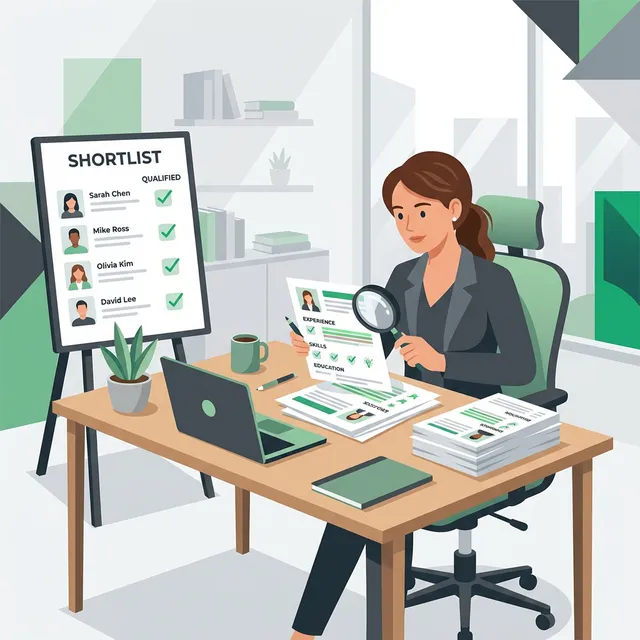
There is a massive gap between CV advice and CV reality. Most articles tell you what a CV should contain. Very few tell you what actually happens on the other side of the screen.
So here it is. The actual recruiter experience. What they do, what they notice, what makes them stop scrolling, and what sends your application straight to the archive.
The 7-Second Scan Is Real. But It's Misunderstood.
You've heard the stat. Recruiters spend 7 seconds on a CV. And technically, that's true for the first pass. But here's what that actually means in practice.
The first 7 seconds aren't about reading. They're about pattern recognition. A recruiter opens your CV and their brain is doing one thing: does this person look like what I'm looking for? Not "are they qualified." Just "do they look right."
If the answer is maybe or yes, they go back and actually read. If the answer is no, they're already opening the next one. That's the whole game in those first seconds.
What drives that instant yes or no? Four things, in this order:
- Current or most recent job title. Does it match the role they're hiring for? A recruiter hiring a "Product Manager" who sees "Senior Product Manager" or "Associate PM" is already leaning in. They see "Office Administrator" and they're already moving on, regardless of what else is on the page.
- Most recent company. Is it recognizable? Is it in the right industry? A name they know signals lower risk. A name they don't know makes them work harder. Not impossible, just harder.
- Career trajectory. Are you going up? Flat progression or backward steps require explanation , and in 7 seconds, there's no room for explanation.
- Overall layout. Is this easy to read or does it look like a furniture assembly manual? Dense text, tiny fonts, cluttered columns , all of these signal effort that the recruiter doesn't have time for right now.
That's it. Four data points. Seven seconds. Go.
"I'm not reading your CV in the first pass. I'm looking at it. There's a difference. If it looks right, then I read it. If it doesn't look right, I'm already on the next one."
, In-house recruiter, tech company, 6 years experienceAgency Recruiters vs In-House Recruiters , They Are Not the Same
This is something almost no CV advice covers. But it changes how you should think about your application.
Agency recruiters work for a staffing or recruitment agency. They get paid when they place a candidate. They're often managing multiple vacancies across multiple clients at the same time, working fast, and looking for the most placeable candidate , not necessarily the best one for the role. They care deeply about ATS keyword matching because their systems auto-score CVs before a human even looks.
In-house recruiters are employees of the company you're applying to. They usually care more about culture fit, long-term potential, and whether you'd actually be good at this specific job. They tend to read more carefully and are more likely to look past an imperfect CV if the experience looks right.
Why does this matter? Because if you're applying through a job board to a large company, you're almost certainly going through an agency or ATS first. Your CV needs to pass a machine scan before a human sees it. If you're applying directly on a company's careers page to a small or mid-size company, there's a decent chance an in-house recruiter or even the hiring manager sees it first.
Same CV. Different optimization strategy depending on who reads it first.
What Happens to Your CV After 48 Hours
Here's the thing nobody tells you. On most platforms, the bulk of applications for a posting arrive in the first few days, not at the closing deadline. The exact share varies by platform, geography, and role (any "X% in the first 48 hours" number you see floating around is a platform-level observation, not a universal labor-market law), but the practical takeaway is the same: applying within the first day or two often matters more than how you apply on day ten. In 2026 this is reinforced by AI screening layers (Pin, GoPerfect, Eightfold, hireEZ) that increasingly sit above the ATS and surface qualified candidates to recruiters faster than the recruiters themselves can review.
So by the time you apply on day 5, the recruiter already has a shortlist of 8-10 candidates they're excited about. They're still technically reviewing, but their motivation to add more names to that list is low. You have to be noticeably better than what they already have to break in.
Apply early. Not recklessly early , take the time to tailor your CV properly. But don't sit on an application for 3 days "perfecting" it. A solid CV sent on day 1 beats a perfect CV sent on day 6, almost every time.
Real talk: Set up job alerts on LinkedIn, Indeed, and any industry-specific boards. Apply within 24 hours of a posting going live. Your competition is smaller and the recruiter is fresh. That combination matters more than most people realize.
The LinkedIn Check They Always Run
Before a recruiter picks up the phone or sends you an email, they check your LinkedIn. Almost every time. It takes 30 seconds and it tells them things your CV doesn't.
They're looking for five things:
- Consistency. Does your LinkedIn match your CV? Different dates, different job titles, or a role on your CV that isn't on LinkedIn is an immediate red flag. It suggests either sloppiness or exaggeration.
- Recommendations. Do other people vouch for you? Even one or two genuine recommendations from managers or colleagues adds credibility that a CV alone can't provide.
- Activity. Are you engaged in your field? Sharing articles, commenting on industry posts, writing occasionally , this signals that you actually care about the space you work in. Silence isn't disqualifying, but activity is a plus.
- Mutual connections. If the recruiter or hiring manager shares a connection with you, that's an informal reference opportunity. They might reach out to that person before they even talk to you.
- Photo and presentation. Professional headshot, coherent summary, clean profile. None of this is mandatory but it all factors into the overall impression.
Keep your LinkedIn current and consistent with your CV. It takes an hour and it pays off every time someone looks you up.
What Actually Gets You Into the Yes Pile
Not "action verbs." Not "dynamic" or "results-oriented." Here's what actually works.
Obvious relevance in the first 10 lines
Your CV should answer the recruiter's question before they even have to ask it. The question is always "why is this person right for this role?" Your job title, your most recent experience, and your personal summary should all scream "this is exactly the person you're looking for." If a recruiter has to dig past the first half of your CV to figure out why you're applying, you've already lost most of them.
Numbers. Real ones.
Not "improved sales performance" but "grew quarterly revenue by 34% to آ£2.1M." Not "managed a team" but "led a team of 9 across two time zones." Numbers do two things: they prove impact and they make your CV scannable. A recruiter's eye naturally stops on a number in a block of text. Use that.
Progression that makes sense
Promotions. Increasing scope. Bigger companies or bigger responsibilities over time. Recruiters are pattern matchers and they're looking for the pattern of someone who keeps getting better. If your career looks flat, find ways to show growth even without a title change , bigger teams, more budget, expanded remit.
A summary that's actually specific
This is the most wasted section on most CVs. Three sentences that could have been written about literally anyone in the profession. "Experienced marketing professional with a passion for driving results." Cool. So is everyone else applying. Make it specific , your actual specialty, your most notable achievement, and what you're looking to do next.
Instant Rejection Triggers
These don't require deliberation. They're reflexive. Any recruiter who sees these is already moving on.
- Typo in your name, email, or phone number. Not just embarrassing , genuinely disqualifying for many roles. If you can't proofread your own contact details, what does that say about your work?
- Unexplained gaps over 6 months. Gaps are fine. Unexplained gaps are not. A brief note , "career break: family care" or "self-employed: freelance projects" , removes the red flag entirely.
- Job hopping with no pattern. Three jobs in two years isn't automatically bad. Three jobs in two years across completely different industries with no connecting thread is a problem. Context matters.
- A CV that's clearly been sent everywhere. A personal summary that mentions a different company, a cover letter that addresses the wrong hiring manager, or a CV that lists skills completely irrelevant to this role , these signal that you're not actually interested in this specific job.
- Walls of text. Dense paragraphs with no white space, no bullet points, no visual hierarchy. A recruiter sees this and immediately calculates how much effort it would take to extract the relevant information. The answer is "too much."
- The unprofessional email. hotlips99@hotmail.com was funny in 2003. firstname.lastname@gmail.com takes 2 minutes to create and removes a reason to question your judgment.
The one that kills more applications than anything else: A generic CV sent to every job. Recruiters can tell. It's not just about keywords , it's the vibe of a document that was clearly never meant specifically for this role. Customization doesn't mean rewriting everything. It means adjusting your summary, reordering your top bullet points, and making sure the language in your CV reflects the language in the job description.
What Recruiters Wish You Actually Knew
These come straight from conversations with recruiters. Not HR blog posts. Actual people who screen CVs for a living.
Your cover letter is read after your CV, not before. Most job seekers agonize over the cover letter and rush the CV. It's the wrong priority. Your CV gets you into consideration. Your cover letter explains the "why" once they're already interested. Get the CV right first.
One follow-up is professional. Two is memorable for the wrong reasons. Sending a polite follow-up email one week after applying is completely reasonable. Sending three follow-ups and a LinkedIn message is how you get flagged as someone who doesn't read social cues.
Referrals actually work. Not because of favoritism , because the recruiter now has a data point they trust. Someone they know vouches for you. That's information the CV can't provide. If you know anyone at the company, even loosely, ask them to refer you. It genuinely helps.
The interview starts with your CV. Every question a recruiter or interviewer asks comes from your CV. The gaps, the transitions, the achievements , all of it gets examined in the room. Know your own CV cold. Be ready to talk confidently about every line on it.
They google you. Not always, not immediately. But before a final decision, most hiring managers will search your name. What comes up? Old social media posts, a dormant personal website, articles you've written, your GitHub, your portfolio. Think about what your digital footprint says about you.
The CV Elements Recruiters Actually Score Mentally
When a recruiter reads your CV properly , past the initial scan , here's roughly what they're weighing.
| Element | What They're Asking | Weight |
|---|---|---|
| Job title match | Is this person doing similar work right now? | Very high |
| Company relevance | Is their background in the right space? | High |
| Achievement quality | Do they have real proof of impact? | High |
| Career progression | Are they getting better over time? | Medium-high |
| Personal summary | Do they know who they are and what they offer? | Medium |
| Skills section | Do they have the technical requirements? | Medium |
| Education | Does it meet the minimum bar? | Low-medium |
| Formatting | Is this easy to read? | Baseline |
Notice formatting is at the bottom. It's not unimportant , a badly formatted CV gets rejected on sight. But once it clears the "readable" bar, formatting stops mattering. Substance takes over.
Frequently Asked Questions
How long do recruiters spend looking at a CV?
6 to 8 seconds on the first pass. That scan is about pattern recognition , does this person look relevant? If yes, they go back and read properly. The top third of your CV carries the most weight in those first seconds.
What do recruiters look at first on a CV?
Current or most recent job title, then company, then career progression, then overall layout. Your personal summary is usually read after these, not before.
Do recruiters check LinkedIn after reading a CV?
Almost always. They check for consistency with your CV, recommendations, mutual connections, and general professional presence. Make sure your LinkedIn is current and matches what your CV says.
What instantly gets a CV rejected?
Typos in contact details, unexplained employment gaps, dense unreadable formatting, a generic summary that could apply to anyone, and a CV that is clearly not customized for the role.
Is it better to apply early to a job posting?
Yes. Most applications come in within 48 hours of posting. Recruiters review as they go, so they often have a shortlist by day 3. Applying early when their attention is fresh and competition is smaller significantly improves your odds.
Key Takeaways
- The 7-second scan is about pattern recognition, not reading , your top third decides your fate
- Agency and in-house recruiters have different priorities , know which one you're dealing with
- Apply within 48 hours , the recruiter is fresher and your competition is smaller
- LinkedIn gets checked before every call , keep it consistent and current
- Numbers, real progression, and obvious relevance get you into the yes pile
- Generic CVs are spotted immediately , customization isn't optional
Build a CV That Passes the 7-Second Test
FreeCV's templates are built to make the right information land in the right place at first glance. Clean, ATS-safe, and recruiter-approved.
Start Building Free →Not Sure How Your CV Reads?
Run your CV through our free ATS scanner. See exactly what a recruiter sees when they open your CV.
Scan My CV Free →