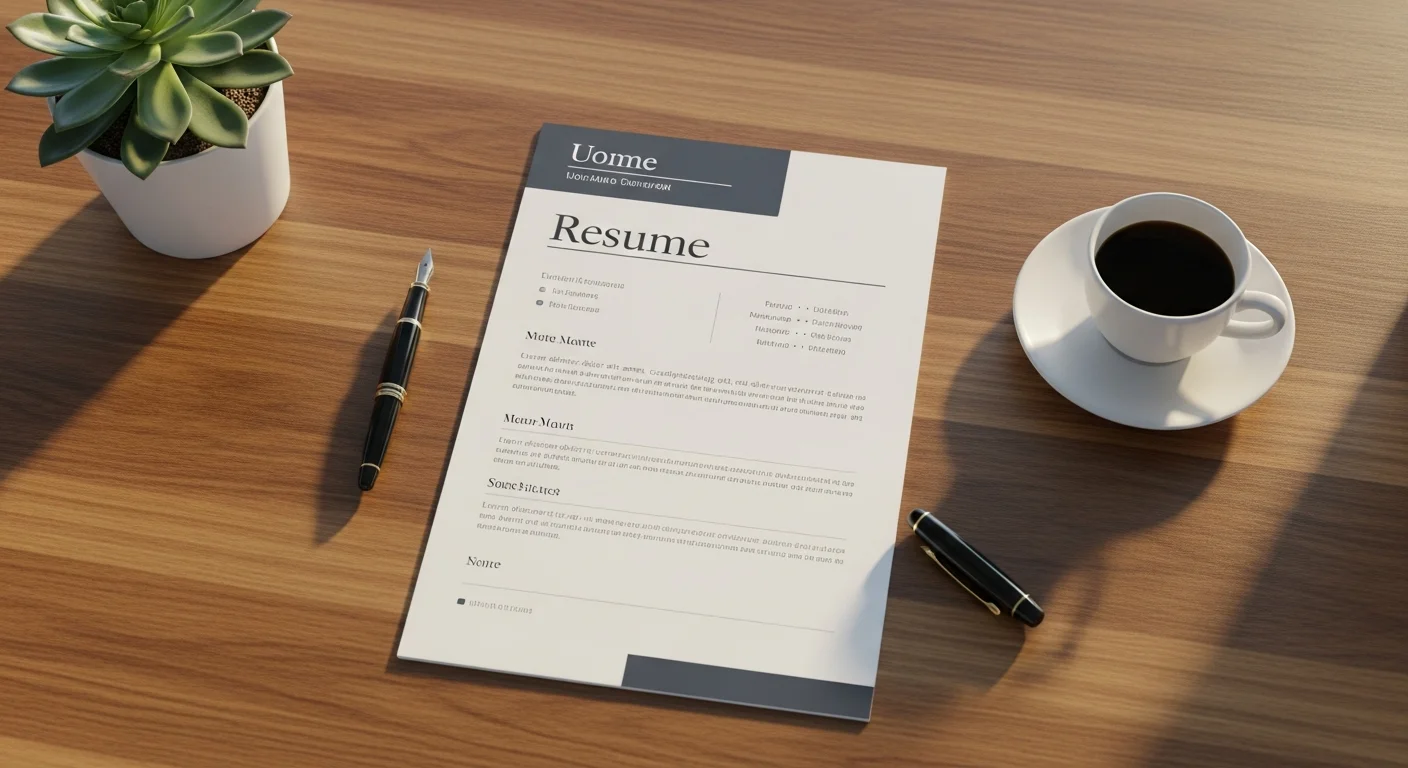
Theodore Bekele, a senior recruiter with fifteen years of experience, glances at the clock. It’s 4:17 PM. He has 112 applications for a single product manager role. He opens the next PDF. His eyes scan in a rapid F-pattern, from top-left across the header, down the left side for job titles, then across for a few bullet points. He’s looking for a spark, a number, a sign of life. He spends six seconds on the first page. He never gets to page two. He closes the file and moves to the next. For the 87 applicants who submitted two pages, their entire story beyond that first sheet might as well not exist. Your one page isn’t just the summary of your resume. It is your resume.
The Brutal Reality of the Six-Second Scan
You’ve probably heard the six-second stat. It’s not a myth meant to scare you. It’s an observation of reality. An eye-tracking study by TheLadders confirmed that recruiters spend an average of just 7.4 seconds conducting an initial screen of a candidate’s resume. In that time, they’re not reading. They’re pattern matching. They scan for job titles, company names, start and end dates, and specific keywords related to the role. Anything that requires a deep read or a page turn gets pushed to the ’maybe’ pile, which is often a polite term for the trash.
This isn’t because recruiters are lazy. It’s a function of volume. When a single corporate job posting on LinkedIn can attract 200 applicants within the first week, triage is the only survival strategy. A concise, powerful, single-page document respects this reality. It’s a strategic choice that signals you understand the rules of the game. You’ve curated your experience, highlighting only the most relevant and impactful details. A sprawling, multi-page document, by contrast, can signal a lack of focus or an inability to distinguish what’s truly important. It puts the burden of discovery on the reader, a reader who simply doesn’t have the time.
Your goal isn’t to tell your entire life story. It’s to survive the initial six-second cull and earn a longer, more detailed review. A well-designed one page resume template is your ticket to that second look. It forces you to be disciplined, to quantify your achievements, and to present your career narrative in its most potent form. It’s not about hiding your experience; it’s about showcasing the absolute best of it.
When One Page is Law (And When to Break It)
The one-page rule isn’t universal, but for a huge swath of the professional world, it’s the unwritten law. If you fall into one of the following categories, you should be fighting to keep your resume on a single sheet of A4 or Letter-sized paper. It’s the standard, and deviating from it can make you look out of touch.
This rule is especially firm for professionals in the United States, Canada, and the United Kingdom. In these markets, brevity is prized. For entry-level candidates and recent graduates, there’s no question; you don’t have enough experience to warrant a second page. For professionals with under 10 years of experience, one page is still the gold standard. You should be able to distill a decade of work into a single, high-impact document. Career changers also benefit immensely from the one-page format. It allows you to create a tightly focused narrative around your transferable skills, rather than getting bogged down in the details of a previous, irrelevant career path.
However, there are specific, recognized exceptions. If you have over 15 years of deep, relevant experience, particularly in senior leadership or highly technical roles, a second page can be justified. The key word is justified. Every line on that second page must still be packed with value. Academics and scientists with extensive lists of publications, presentations, and research projects will need a multi-page Curriculum Vitae (CV), not a resume. The same applies to medical doctors and some C-level executives. Finally, applications for federal government jobs often require a specific, highly detailed resume format that can easily run to four or five pages. If you’re not in one of these niche categories, stick to one page. For more detail, you can read our full guide on how long a resume should be.
The Architecture of a Perfect Page
Getting everything to fit without it looking like a wall of text from a 1990s legal disclaimer is an exercise in precision. This isn’t about just shrinking the font until it’s illegible. It’s about using space intelligently. The best one page resume template designs are built on a foundation of strict typographical rules.
First, let’s talk margins. Your margins should be between 0.5 and 0.7 inches on all four sides. Anything smaller, and the page becomes a claustrophobic mess that’s visually overwhelming. Anything larger, and you’re wasting precious real estate. Next, fonts. Stick to professional, readable sans-serif fonts like Calibri, Helvetica, or Arial, or a classic serif font like Garamond. Your body text should be 10pt or 11pt. Your name at the top can be larger, perhaps 12pt to 14pt, with section headers a point or two larger than the body. Don’t go below 10pt for the body text; you want the recruiter to be able to read it without squinting.
Line spacing is another critical element. Keep it between 1.0 and 1.15. This provides enough separation between lines to ensure readability without eating up too much vertical space. The final, and perhaps most important, principle is white space. A good resume should have a white space to text ratio of around 35 percent. This negative space gives your content room to breathe, guiding the reader’s eye to the most important sections. It’s the difference between a document that feels calm and professional and one that feels frantic and desperate. Our free resume templates are all designed with these principles in mind.
The Necessary Art of The Cut
To fit your career onto a single page, you must become a ruthless editor. You’re not just summarizing; you’re curating. The first thing to go is the fluff. That means deleting the "Objective" statement. It’s an outdated relic. The recruiter knows your objective is to get the job you applied for. Replace it with a tight, 2-3 line "Professional Summary" that highlights your top skills and key achievements right at the top.
Next, kill the line "References available upon request." It’s completely redundant. If a company wants your references, they will ask for them. That one line of text is better used for a bullet point that quantifies an achievement. For candidates in the US, UK, or Canada, remove your photo. It’s not standard practice and can introduce unconscious bias into the hiring process. It also takes up valuable space and can cause issues with Applicant Tracking Systems (ATS).
The most significant cuts will come from your work history. You do not need to list every job you’ve ever had. The general rule is to focus on the last 10-15 years. That summer job you had in college? Gone. That first entry-level role from 12 years ago? Condense it to a single line or remove it entirely. For your most recent and relevant roles, aim for 4-5 powerful, metric-driven bullet points. For older roles, trim it down to 2-3. Instead of saying "Responsible for social media," write "Grew Instagram following by 300% to 50k followers in 12 months, resulting in a 15% increase in inbound leads." Every bullet point should prove your value, not just list a duty.
Column Wars: The Single-Column Advantage
When you browse resume designs, you’ll see a lot of two-column layouts. They look modern and can be an efficient way to organize information, often placing skills or contact info in a narrow side column. While visually appealing, they come with a significant risk: Applicant Tracking Systems. An ATS is software used by most large and medium-sized companies to parse and sort resumes before a human ever sees them.
These systems are notoriously bad at reading complex layouts. An ATS typically reads a document from left to right, top to bottom. When it encounters a two-column format, it can get confused. It might read straight across the page, jumbling the content from both columns into a single, nonsensical line of text. This can result in your carefully crafted experience section being rendered as gibberish, or your contact information being missed entirely. Your resume gets sorted into the rejection pile by a robot, and you never even had a chance.
For this reason, a traditional single-column resume is almost always the safer bet. It presents your information in a simple, linear flow that an ATS can easily understand. This doesn’t mean it has to be boring. You can still use typography, white space, and subtle design elements to create a clean, professional look. If you’re applying to a large corporation, always err on the side of caution and choose a single-column one page resume template. If you’re applying to a small startup or a design-focused role where you’re sure a human will see it first, a two-column format might be acceptable. But why take the risk?
One Page, Three Ways: Templates for Your Career Stage
A one-page resume is not a one-size-fits-all document. Its content and focus must change dramatically depending on where you are in your career. The strategy for a new graduate is entirely different from that of a seasoned professional making a career pivot.
The New Graduate:You lack formal work experience, so you need to showcase potential. Your "Education" section goes near the top, right after your summary. Include your GPA if it’s above a 3.5. The bulk of your resume should be an "Projects" section. Detail 2-3 significant academic or personal projects. Describe the problem, the tools you used (e.g., Python, Figma, a specific lab technique), and the outcome. Use bullet points to quantify what you did. For example: "Developed a full-stack web application using the MERN stack to track personal fitness goals, resulting in a 10% user retention rate during beta testing." Also, include an "Internships" section, treating it just like a professional job with metric-driven bullet points. Our CV examples section has more ideas.
The 5-Year Mid-Career Professional:You have a track record of success. Your resume should be a highlight reel of your accomplishments. Lead with a strong "Professional Summary" that states your title, years of experience, and 2-3 major achievements. Your "Work Experience" section is the star of the show. Use the STAR method (Situation, Task, Action, Result) to frame your bullet points. Every bullet should answer the question "so what?" Don’t just list what you did; show the impact. Bad: "Managed email marketing campaigns." Good: "Led a targeted email marketing strategy for a 200k subscriber list, achieving a 25% open rate and 5% CTR, which generated $500k in attributable revenue in Q4 2025."
The Career Changer:Your challenge is to connect the dots between your past and your future. Your resume must be laser-focused on the new role. The "Professional Summary" is your most important tool. It must explicitly state your intention to pivot and highlight 3-4 key transferable skills. For example: "Project Manager with 8 years of experience in the logistics industry transitioning into a technical product management role. Proven expertise in stakeholder communication, agile methodologies, and data analysis to drive product roadmaps and deliver features on time." Your "Skills" section should be prominent and tailored to the new industry’s keywords. In your "Work Experience," reframe your bullet points to emphasize these transferable skills, even if the context was different. A logistics manager’s experience coordinating shipments can be framed as "managing complex, multi-stakeholder projects under tight deadlines."
A Recruiter’s View on the Gift of Brevity
We spoke to Mei Tan at Foreshore Recruiting about what goes through her mind when she sees a perfectly crafted one-page resume. She doesn’t see a lack of experience. She sees a valuable professional skill.
"Giving me a one-page resume is a gift," Mei says, her voice warm but direct. "It tells me you respect my time. You’ve done the hard work of synthesis, so I don’t have to. It shows me that you can communicate clearly and effectively, which is a critical skill in any role. You’ve identified what’s truly important about your career, and that clarity is more impressive than a list of every task you’ve ever performed. When I see that, I know I’m dealing with a focused, confident professional. It’s an act of professional empathy, and it makes me want to learn more."
That’s the core of it. Your resume isn’t just a document. It’s the first conversation you have with a potential employer. A concise, powerful, one-page resume starts that conversation on the right foot, showing respect, clarity, and confidence before you’ve even spoken a word.
Choosing Your Resume Building Tool
Once you know what to include, you need the right tool to build it. While you can wrestle with tables in a word processor, dedicated builders offer a much smoother experience. Here’s how they stack up.
| Feature | Microsoft Word | Zety | Resume.io | FreeCV.org |
|---|---|---|---|---|
| Cost | Free (with Office) | $2.70 for 14 days, then $23.70/mo | $2.95 for 7 days, then $24.95/mo | Completely Free |
| ATS Friendliness | User-dependent | Good, but some templates are risky | Good, but complex templates can fail | Excellent, all templates ATS-tested |
| Template Quality | Basic, requires heavy formatting | Modern, but many are two-column | Stylish, but can be hard to edit | Professional, clean, and flexible |
| Ease of Use | High effort, manual formatting | Easy, guided process | Simple interface | Intuitive, real-time preview |
| Hidden Fees | None | Aggressive upselling, auto-renews | Auto-renews, hard to cancel | None. Free means free. |
As the table shows, while paid builders offer slick interfaces, they often come with subscription traps and templates that aren’t optimized for modern recruiting software. A tool like our free CV builder gives you professionally designed, ATS-friendly templates without any cost or hidden fees.
Frequently Asked Questions
How do I format a one-page resume?
To format a one-page resume, set your margins to 0.5-0.7 inches and use a professional 10-11pt font like Calibri or Garamond. Use single line spacing (1.0-1.15) and ensure there’s plenty of white space to guide the reader’s eye. Structure it with a clear hierarchy: your name and contact information at the top, followed by a professional summary, skills, work experience, and education. Use bolding for job titles and company names to make the document easy to scan.
What font size should I use for a one-page resume?
The ideal font size is between 10 and 11 points for the main body text. This ensures readability for the recruiter without sacrificing too much space. Your name can be larger, between 12 and 14 points, to make it stand out. Section headers (like "Work Experience" or "Skills") can also be slightly larger, around 12 points, to create a clear visual structure. Never go below 10 points for body text, as it becomes difficult to read both on-screen and in print.
Can you fit 10 years of experience on one page?
Yes, you can absolutely fit 10 years of experience on one page, and it’s the standard expectation in most industries. The key is to be selective. Focus on your most recent and relevant roles, giving them 4-5 detailed, metric-driven bullet points each. For older positions from 7-10 years ago, condense them to just 2-3 bullet points. Any experience beyond 10-15 years can typically be removed entirely, unless it’s exceptionally relevant to the job you’re targeting.
What margins should I use for a one-page resume?
You should use margins between 0.5 inches and 0.7 inches on all four sides of your resume. This provides a good balance, maximizing the usable space on the page while still leaving enough white space around the edges to prevent a cluttered, overwhelming look. Margins smaller than 0.5 inches can make the document look crammed and difficult to read, and some printers may even cut off the text.
Is a one-page resume better in 2026?
Yes, a one-page resume is still considered better for the vast majority of professionals in 2026. With recruiters spending mere seconds on initial screenings, a concise document that presents your most compelling qualifications immediately is far more effective. It demonstrates your ability to synthesize information and respect the hiring manager’s time. The only major exceptions are for those in academia, federal government, or with 15+ years of highly technical senior-level experience.
How do I shrink my resume to one page without losing content?
Shrinking your resume is about strategic editing, not just deleting things. Start by reformatting: tighten margins (to 0.5"), reduce line spacing (to 1.0), and ensure your font is an efficient but readable 10pt. Next, edit your content. Rewrite long, descriptive sentences into short, powerful bullet points that start with an action verb. Combine related points and cut any that don’t directly support your candidacy for the target role. Remove your street address (city and state are enough), the "references" line, and any jobs older than 15 years.
You have the strategy. You have the rules. The only thing left is to build the document that gets you the interview. Don’t just list your history; tell your most powerful professional story in the space of a single page.
The patterns above are baked into the free CV builder. Pick a template, the AI fills the gaps, and you download a clean PDF in minutes.
Start free →