
You tailored the resume. You used the right words. You hit submit. And then nothing. No call, no email, not even a polite rejection. Just a void where a reply should be. If that keeps happening, the problem usually is not you. It is that you are writing for a human reader who never gets to see the page.
A single open role now pulls a thousand or more applications, sometimes within a couple of days. No team reads all of those. So software reads them first, ranks them, and hands a short list to a tired person with a coffee. Beating that software is the whole game in 2026. The good news is the rules are knowable. The annoying news is that most advice online is still teaching you to beat a system that retired years ago.
The short version: in 2026 your resume faces two AI gatekeepers. The Bouncer matches exact keywords and runs the knockout questions. The Investigator reads for meaning and scores how well you fit the role. The PIVOT method, which is Parse, Isolate, Validate, Optimize and Test, is the one move that satisfies both, because it puts the exact words from the posting inside real, quantified achievements.
So let us open the box and look at what actually happens to your file after you click apply. No mystique, no fear mongering, just the pipeline.
Meet the two gatekeepers
Here is the thing nobody tells you. There is not one AI screener. There are two, stacked on top of each other, and they judge you by completely different rules. I think of them as the Bouncer and the Investigator.
The Bouncer (the old rule based filter)
The Bouncer is dumb and proud of it. It does not read. It checks. Does this person have the required license? Are they allowed to work here? Did they list the exact tool the posting demanded? It matches words literally, so “project management” does not always catch “managing projects.” It also runs the knockout questions, the yes or no gates like work authorization and location. Fail one of those and you are gone before any cleverness can save you. The Bouncer has been around forever and it is still standing at the door.
The Investigator (the new semantic and language model layer)
The Investigator is the part that got scary good recently. It turns your resume and the job description into numbers that capture meaning, then measures how close they sit. This is the part people mean when they say embeddings or semantic search. In plain terms, it can tell that “led a team of twelve through a nine month launch” means project management, even if you never wrote those two words. On top of that, some systems add a language model that reads your resume almost like a person would. It can guess your seniority, write a quick summary of you for the recruiter, and notice when a section is all buzzwords and no substance.
The big names blend both jobs together now. Most modern systems, Workday, Greenhouse, Lever and Workable among them, run the rule based checks and bolt on AI matching inside the same product. Talent platforms like Eightfold, Beamery and Phenom add a heavier matching and sourcing layer on top. A specialist parser, the kind from Textkernel or Daxtra, often does the actual reading in between. You do not need to memorize the brands. You need to know that two very different judges are looking at the same page.
| Gatekeeper | What it actually does | What makes it say yes |
|---|---|---|
| The Bouncer | Matches exact words, runs knockout questions, applies hard filters | The exact job title, tools and certifications from the posting, spelled their way |
| The Investigator | Reads for meaning, scores how close you sit to the role, summarizes you | Real achievements with numbers and context, not a wall of keywords |
| The Human | Skims the short list the software handed over, in seconds | A page that reads like a real person who clearly did the job |
Almost every “beat the ATS” guide online optimizes for the Bouncer and forgets the Investigator exists. That is why people stuff keywords, pass the first check, and still vanish. They got through the door and then bored the second judge to sleep. The trick is one move that satisfies both, and I will get to that. First, the lies you should stop believing.
Five myths that are quietly sinking your resume
This advice was fine in 2018. In 2026 it ranges from useless to actively harmful.
Keyword stuffing works
A dense block of skills with no sentences around them used to game the old filter. Now the Investigator reads it as noise and the recruiter reads it as desperate.
Do this Put every important keyword inside a real sentence about something you actually did.
Hidden white text is a clever hack
Typing extra keywords in white on white to sneak them past the scanner. The moment a human opens the file or highlights the page, it is right there, and it looks exactly as dodgy as it is.
Do this Never. There is no upside and the downside is your reputation.
A gorgeous two column design stands out
That Canva template with the sidebar and the little skill bars looks amazing to you and like scrambled soup to a parser that reads left to right across the page.
Do this Submit a clean single column file. Keep the designed version for your portfolio and your ego.
Creative section headings show personality
“Where I have been” instead of Experience. The parser shrugs and files your best work under nothing.
Do this Use the boring labels. Experience, Education, Skills. Boring parses perfectly.
One resume for every job
The same file blasted at forty postings matches none of them well, because every posting weighs different words.
Do this Keep a master, then retune the top third for each role.
75% of resumes get auto rejected
This famous stat traces back to a recruiting tool that was discontinued years ago, with no current source behind it, and it keeps getting copied anyway. Most systems rank and sort, they do not mass delete.
Do this Stop fearing a phantom delete button and start worrying about the knockout questions, which really do bin you.
The PIVOT method
Everything above points at one move. You want the exact words the Bouncer is checking for, sitting inside the kind of real, specific writing the Investigator rewards. That is the whole secret, and it fits in five steps. I call it PIVOT because that is genuinely what it does to your results, and because a memorable name beats a list you forget by lunch.
P is for Parse
Before anything reads your words, something has to read your file. Give it the easiest possible job. Single column. Standard fonts. Real text, never an image of text. Boring headings. No tables, no text boxes, no icons doing the work of words. If your layout is clean, the parser captures every line. If it is not, your best achievement can land in a field labeled nothing and quietly disappear. You can build a layout like this in about a minute in the FreeCV builder, which is single column and parser safe by default.
I is for Isolate
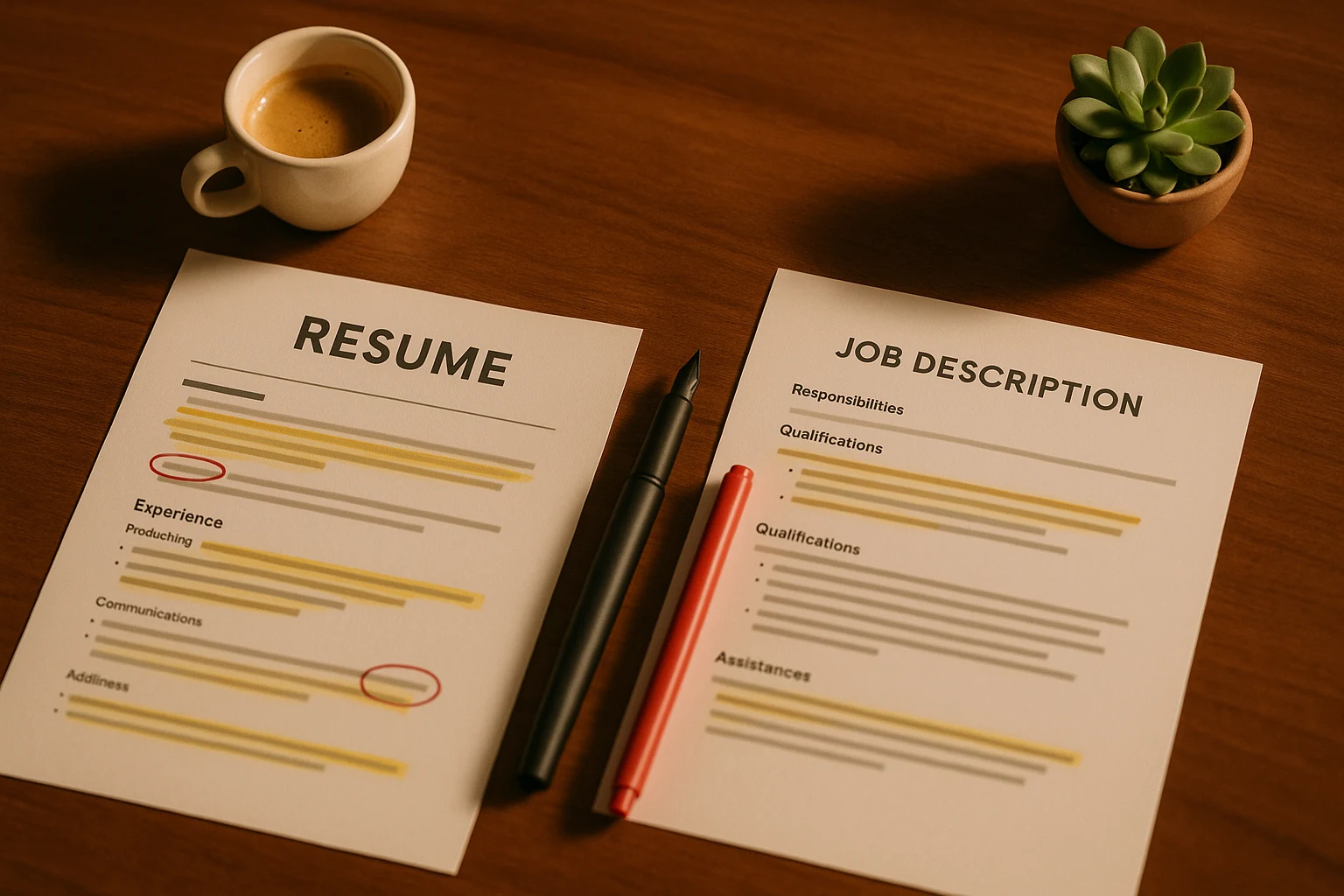
Open the job description and find the five to seven things that actually matter. The exact job title. The named tools, like Salesforce, Figma, Tableau or Jira. The required certifications. The two or three skills the posting repeats, because repetition is the employer telling you what they care about. Those are your must have terms. Ignore the fluff about being a self starter who thrives under pressure. Everyone writes that. Nobody screens for it.
V is for Validate
This is where most people fumble. They take their isolated keywords and dump them into a skills line, then wonder why the meaning layer ignores them. Do the opposite. Prove each keyword by wrapping it in a real thing you did, with a number attached. Watch what that does to a single bullet.
Responsible for social media marketing and email campaigns.
Ran paid social on Meta and TikTok with a $50k quarterly budget and grew qualified leads 18% in two quarters.
You do not need to invent numbers, and please do not. If you grew something, by roughly how much? If you saved time, how many hours a week? If you managed people, how many? Real and approximate beats vague and impressive every time, and it survives the interview, which fake numbers never do.
O is for Optimize
One generic resume is dead. Not because tailoring is noble, but because each posting weighs different words, and the Investigator is comparing you to that specific posting. The fix takes about ten minutes per role. Rewrite the summary to mirror the job title. Reorder your skills so the posting’s top requirements come first. Rework two or three bullets to carry the must have terms you isolated. You are not rebuilding the resume. You are retuning the top third, which is the part both gatekeepers weigh most.
T is for Test
Do not guess whether it worked. Check. Paste your resume and the job description into a scanner and look at the match and the missing terms, then close the gaps that are real. We recommend aiming for a strong match, somewhere in the seventy to eighty percent range, not a perfect score. A hundred percent match usually means you copied the posting back at it, and both the software and the human can smell that. You can run this in the FreeCV ATS checker against any job description before you send.
Quick answer on PDF versus Word
People lose sleep over this and they should not. Modern systems read a text based PDF and a .docx without trouble. A .docx is the slightly safer bet for older setups, and a clean PDF keeps your formatting steady everywhere. The only file that genuinely breaks is an image or a scan, because the parser is left squinting at pixels. If a posting names a format, give it that one. Otherwise pick either and move on with your life.
The next frontier, and where this is honestly heading
Now for the part most articles will not tell you straight, because it is less fun than a hack. Today the mainstream screeners parse the file you upload. They do not pull data from your personal website or read a JSON file you publish. So no, posting a fancy machine readable CV will not bump your score at Workday tomorrow. Anyone promising that is selling something.
But the way recruiters find people is shifting under our feet. More of them search the open web, and a growing number lean on AI tools to do the looking. Ask an AI assistant to find candidates who scaled paid social at a mid size SaaS company, and it goes hunting across whatever is public and readable. That is a different game, and it rewards being findable, current and clean.
This is the honest case for a live, public CV. A livelink.cv page with a cv.json file gives you one permanent URL that stays current, that a recruiter can find from a quick search, and that an AI sourcing agent can read without guessing, because it is structured data instead of a parsed guess from a PDF. It will not beat today’s Bouncer. It quietly sets you up for the recruiter, and the AI, who come looking tomorrow.
And while you are at it, write like a person. The Investigator and the recruiter both perk up at specifics and both glaze over at the same tired filler. If you want the receipts on which exact words flag a resume as machine written, we counted them in a separate piece on the words that make a resume look AI written. Pair that with a clean layout and a couple of real numbers and you sound like someone worth a call.
- ✓Single column, standard headings, real text, no tables or sidebars in the file you submit.
- ✓Pull the five to seven exact must have terms from each posting, spelled their way.
- ✓Put every one of those terms inside a real achievement with a number, not a keyword list.
- ✓Retune the top third for each role in about ten minutes.
- ✓Answer knockout questions honestly, because that is the real instant reject.
- ✓Scan against the job description and aim for a strong match, not a perfect one.
- ✓Keep a public, current, machine readable CV for the recruiters and AI tools that search.
Frequently asked questions
Will an AI screener reject my resume before a human sees it?
Sometimes, but less often than people fear. Most systems rank and sort applicants rather than auto rejecting them on content. The hard gates are the knockout questions, such as work authorization, location and a required license. Miss one of those and you are out. Score low on keyword and meaning match and you sink down the pile, which has the same effect.
Does keyword stuffing still work in 2026?
No. The semantic layer reads for meaning and flags blocks of disconnected keywords as noise, and recruiters spot a keyword dump in a second. Put each important term inside a real sentence about something you did.
Is a one page or two page resume better for AI screening?
Length is not what the screener cares about. It cares about relevance and clean parsing. One page is plenty under ten years of experience. Two pages are fine for senior or technical roles. Never pad it to hit a number.
PDF or Word for an AI screener?
Both parse fine in modern systems. A text based PDF or a .docx are safe. The only real loser is an image or a scanned page, because the parser cannot read pixels without guessing. If a posting names a format, use that one.
Can recruiters tell if I used AI to write my resume?
Detection tools are unreliable, so most recruiters do not run them. What they do notice is generic, voiceless writing with no specifics. Use AI to draft and tidy, then add your real numbers and your own words so it reads like a person wrote it.
Should I use exact keywords from the job description or synonyms?
Use the exact words for the must have skills, tools and the job title. The rule based filter still matches literally, so project management will not always catch managing projects. Then write naturally around those terms so the meaning layer is happy too.
Do I really need a different resume for every job?
You need a tailored top third for every job. Keep one master resume, then spend about ten minutes per application swapping the summary, reordering the skills and rewriting two or three bullets to match the posting.
Should I spell out acronyms like PMP or MBA?
Yes. Write the full term and the acronym once, for example Project Management Professional (PMP). That way you match whether the system or the recruiter searches for the short or the long version.
Can a fancy two column template hurt me?
It can. Many parsers read a page left to right and scramble two column layouts, sidebars and text boxes. Use a clean single column for the file you submit and save the designed version for your portfolio.
Does a public online CV help with AI search and recruiters?
Today it does not change your ATS score, because the screener parses the file you upload, not your website. But a public, always current CV link is findable by recruiters searching the open web and by AI search tools, and a machine readable version such as cv.json is clean data for the AI sourcing agents that are starting to do the looking.