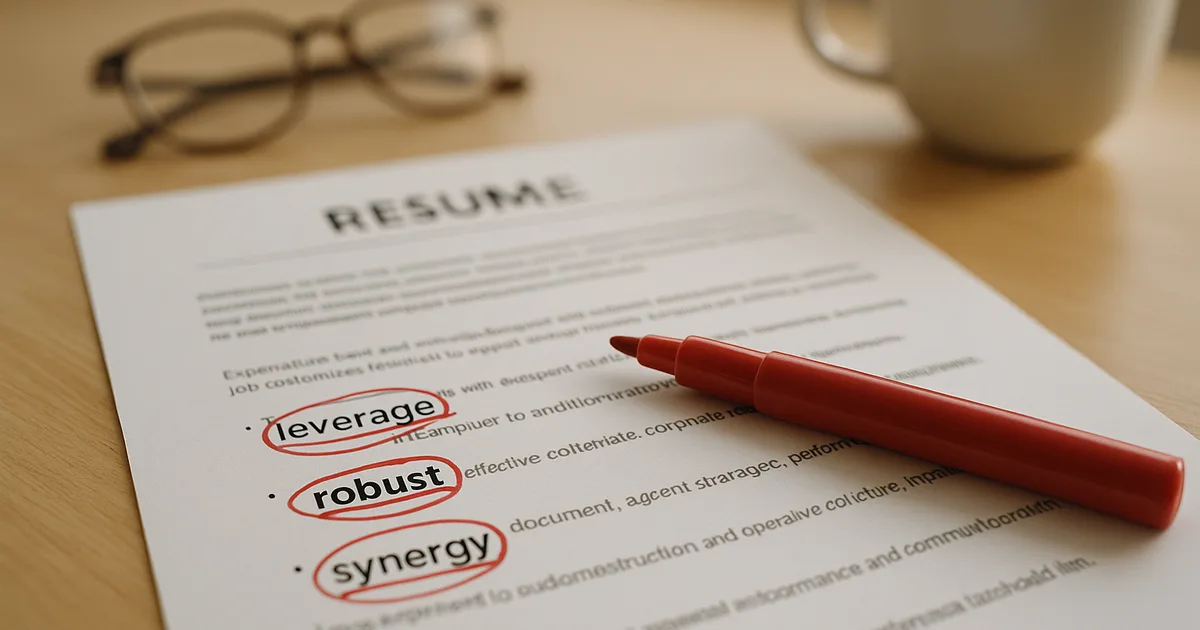
So I had a fight with the internet, and the internet lost.
Here is how it started. Every list of “AI words to delete from your resume” says the same five things. Delve. Tapestry. Synergy. Leverage. Robust. You have read that list. I have read that list. We have all nodded along and deleted “delve” from a bullet we wrote ourselves and felt very clever about it.
But nobody actually checked. Nobody sat down and made a giant pile of AI resumes and counted what is really in them. That bugged me. So I did it.
I didn't trust the AI detector tools either, by the way. They flag honest people and wave through obvious robots. So I built my own detector. It is called counting. Boring, I know. But counting doesn't lie, and it doesn't care what a blog told you in 2024.
Five hundred resumes later, the popular advice looks pretty silly. And the real giveaways turned out to be words you probably have on your resume right now, plus one little punctuation mark that gave away nine out of ten of them. Let me show you.
What I Actually Did (the boring honest part)
No magic. I asked ChatGPT to write 500 resumes, the lazy way a normal person asks. Stuff like “write me a resume for a marketing manager with 5 years of experience” and “make me a resume for a nurse that will get past ATS.” Forty different jobs, from software engineer to electrician to chef. Five hundred resumes in total. Then a script read every one and counted the words.
That is the whole method. No cherry picking. No planting words to find them later. The model wrote whatever it wanted, and I just tallied it up. Which is the only honest way to do this, because the second you pick the words first, you are not measuring anything. You are decorating a conclusion.
First, the Myth: Delve and Tapestry Are a Lie
Let me just rip the bandage off. The most famous “AI tell” words barely exist on resumes. Here is what I found across all 500.
I had to run the count twice because I didn't believe it. Delve, zero. Tapestry, zero. Testament, zero. Pivotal, one. These are the words everyone tells you to hunt down and kill, and ChatGPT basically never writes them on a resume.
And it makes sense once you think about it. “Delve” and “tapestry” are essay words. Blog words. ChatGPT reaches for those when it is writing flowery prose about the human spirit. A resume is a different job. It puts on a suit and writes like a middle manager instead. So the tells are completely different, and the internet has been fighting the last war this whole time.
So if you have been proudly deleting “delve” from your CV, good news. You were never the problem. The actual problem is sneakier.
The Tell That Was in 92% of Them: the Em Dash
Here is the one that stopped me cold.
Nine out of ten. The em dash is the fingerprint. That little horizontal line that is longer than a hyphen, the one ChatGPT sprinkles into everything like seasoning. Most people don't even type it. You have to hold a key combo or let autocorrect do it. So when a recruiter sees three of them in one resume, a quiet little alarm goes off, even if they couldn't tell you why.
This is the single fastest fix in this whole article. Open your resume. Search for the em dash. Replace every one with a period, a comma, or just nothing. You will instantly look more human than 92 percent of the AI resumes in the pile. One find and replace. That is it.
The 14 Words ChatGPT Actually Can't Stop Using
Okay, so if it is not delve and tapestry, what is it? Here are the words that genuinely showed up again and again, ranked by how many of the 500 resumes used each one. These are the real offenders. Notice they all sound like a LinkedIn post wearing a tie.
| The word | % of the 500 | Write this instead |
|---|---|---|
| proficient | 44% | just name the tool. “Excel, SQL, Figma.” Nobody needs the word proficient. |
| detail-oriented | 44% | cut it and show it. A clean, error free resume proves it louder than the claim. |
| proven track record | 43% | state the actual result. “Grew sales 18% in a year” is the proof. |
| results-driven | 40% | delete it and put a real result in the next line. |
| foster | 38% | build, help, or run. “Built relationships with” beats “fostered.” |
| utilize | 37% | use. Always just use. No human says utilize out loud. |
| leverage | 36% | use, or name what you did with it. |
| comprehensive | 36% | full, complete, or cut it entirely. |
| streamline | 30% | simplify, speed up, or cut steps from. |
| stakeholder | 29% | say who. Clients. Managers. The design team. Real people have names. |
| dynamic | 27% | cut it. It describes nobody and nothing. |
| facilitate | 25% | run, lead, or set up. |
| spearheaded | 15% | led or started. Spearheaded is a spear you are throwing at the recruiter. |
| seamless | 8% | smooth, or describe what actually went right. |
Look at that top of the list. Proficient. Detail oriented. Proven track record. Results driven. These are not exotic AI words. They are the tired resume filler we have all been trained to write, and ChatGPT learned it from us and now hands it back at full volume. It is a feedback loop of nonsense.
And “utilize” showed up on more than a third of them. Utilize. Nobody has ever said “I utilized a spoon.” You used the spoon. Use is a perfect word. ChatGPT just thinks “use” isn't wearing enough cologne.
The 5 Tells That Are Not Even Words
The vocabulary is only half of it. The way ChatGPT builds a resume has its own fingerprints, and once you see them you cannot unsee them.
It writes a novel in bullet points
The average AI resume in my pile had 23.7 bullet points. Twenty four bullets. Real resumes breathe. AI ones just keep going, listing every imaginable duty until the page begs for mercy.
The fix Cut to 3 to 5 bullets per job, and only the ones with a real result. If a bullet could be on anyone's resume, delete it.
The rule of three, on a loop
ChatGPT loves a list of three. Fast, reliable, and scalable. Strategic, analytical, and collaborative. I counted 1,163 of these triplets across 500 resumes. That is more than two per resume, like a verbal tic it cannot drop.
The fix When you spot three adjectives holding hands, keep the one that is true and cut the other two.
It leaves the [X]% placeholders in
This one made me laugh. ChatGPT writes “increased efficiency by [X]%” and just expects you to fill in the bracket. Plenty of people don't notice and send it anyway. A recruiter spotting a literal [X]% knows exactly what happened.
The fix Search your resume for a square bracket. Fill it with a real number you can back up, or delete the whole claim.
Bullets that say nothing, loudly
Real example from the pile: “Fostered strong relationships with internal and external stakeholders to facilitate effective communication and collaboration.” Read it again. It contains no information. It is word soup that feels like an accomplishment.
The fix For every bullet ask, what did I actually do, and what happened because of it. If you can't answer both, the bullet is decoration.
Everyone sounds identical
The nurse, the accountant, and the warehouse supervisor all opened with the same flavor of summary. AI pulls everyone toward the same beige middle. Which means your resume reads exactly like the other 200 in the stack.
The fix Add one specific, slightly weird, true detail in your first two lines. A tool, a niche, a number. Specifics are the one thing AI can't fake for you.
Before and After: Real Bullets From the Pile
These are actual bullets ChatGPT wrote in my study, copied straight out, then fixed. Same idea, fewer feathers. Notice the human version never invents a fact. It just stops performing.
“Spearheaded the development and execution of a comprehensive marketing strategy that increased annual revenue by 25% within the first year.”
“Built the marketing plan that grew revenue 25% in year one.”
“Fostered strong relationships with internal and external stakeholders to facilitate effective communication and collaboration.”
“Kept clients and the engineering team aligned through weekly check ins.”
“Streamlined warehouse operations by reorganizing storage layouts, which increased space utilization by [X]% and fostered more efficient picking and packing.”
“Reorganized the warehouse layout, which freed up storage and sped up picking and packing.”
So Can Recruiters Actually Tell?
Short answer, more than you would like. The longer answer is that they are not running detectors. They just feel it.
See how that connects? Recruiters can't name the em dash. They can't recite my word list. But they read fifty resumes before lunch, and the AI ones all hum at the same frequency. Generic words, identical rhythm, that little dash. After a while you smell it without trying.
The fix is not to hide that you used AI. Tons of strong candidates use it. The fix is to not sound like you mailed in the raw output. A human edit anywhere on the page breaks the spell.
Do AI Detectors Even Work? (not really)
You might be thinking, fine, I will just run my resume through an AI detector and clean it up. Careful. Those tools are a coin flip with confidence issues.
A Stanford study found that popular AI detectors flagged about 61 percent of essays written by real humans whose first language was not English. Real people. Flagged as robots. Two thirds of the time. Meanwhile the same tools wave through plenty of actual AI text. So a detector is just as likely to punish a perfectly honest immigrant engineer as it is to catch a lazy copy paste.
And here is the part that surprises people. The big applicant tracking systems, the Workday and Greenhouse and Lever software that actually screens your resume, do not detect AI at all. They scan for keywords and check your formatting. That is it. No robot is sniffing your prose for a soul.
3 Prompts That Strip the Robot Out
You can fix all of this by hand in ten minutes. Or you can make ChatGPT clean up its own mess. These three prompts do exactly that. Copy them, paste your resume under them, done. None of them invent numbers, because that is how you get caught in the interview.
1. The Tell Finder
This one turns ChatGPT into the blunt recruiter who has read ten thousand resumes. It finds the AI words for you so you don't have to memorize my list.
2. The De-Robot
This rewrites your bullets in plain human English while keeping every real fact exactly as it was. The last line is the important one. It tells ChatGPT to never make up a number.
3. The Dash and Bracket Sweep
The thirty second cleanup. This kills the em dash that was in 92 percent of my resumes and catches any [X]% placeholder ChatGPT left behind for you to ship by accident.
The 2026 Problem Nobody Wants to Say Out Loud
Here is where it is heading, and it is a little grim. Everyone now uses the same three or four AI tools to write resumes. Those tools were all trained on similar data. So they all reach for the same words, the same rule of three, the same beige summary.
Which means resumes are converging. A recruiter in 2026 is reading a stack where forty of the fifty applicants used AI, and all forty sound like cousins. The generic resume used to be a personal failure. Now it is the default setting, mass produced.
And that is actually great news for you, if you are paying attention. When everyone sounds the same, the one person who sounds like a human stands out instantly. You don't need to be a brilliant writer. You just need to cut the buzzwords, drop the dash, and put one specific true thing on the page. That is the entire game now. Be the resume that sounds like a person.
Everything above, in seven lines.
- 1Delve and tapestry are not your problem. They showed up zero times in 500 AI resumes. Stop hunting them.
- 2The em dash was in 92% of them. Find and replace it with a period or comma. Fastest fix there is.
- 3The real tells are tired filler: proficient, utilize, leverage, foster, stakeholder, results driven, detail oriented.
- 4Cut to 3 to 5 bullets per job. The average AI resume had almost 24, and most said nothing.
- 5Search for square brackets. ChatGPT leaves [X]% placeholders and people ship them by accident.
- 6Detectors are a coin flip and ATS don't check for AI at all. The real risk is sounding generic, not sounding AI.
- 7One specific true detail in your first two lines beats every buzzword on the page.
Frequently Asked Questions
What words make a resume look AI written?
Based on counting 500 ChatGPT generated resumes, the real giveaways are tired corporate filler, not the exotic words everyone warns about. The most common were proficient (44% of resumes), detail oriented (44%), proven track record (43%), results driven (40%), foster (38%), utilize (37%), leverage (36%), comprehensive (36%), streamline (30%), and stakeholder (29%). The single biggest tell was the em dash, which appeared in 92% of them.
Is delve really an AI word to avoid on a resume?
On a resume, no. In 500 ChatGPT resumes, the word delve appeared zero times. Same with tapestry and testament. Those are essay and blog tells, not resume tells. ChatGPT writes resumes in a stiff corporate voice, so the words it overuses are things like utilize, foster, and proficient, not delve.
Why does ChatGPT use so many em dashes?
It is trained on a huge amount of polished online writing where the em dash is common, so it reaches for it constantly. In my study, 92% of AI resumes had at least one, averaging almost four per resume. Most people never type an em dash by hand, so it stands out to a recruiter even if they cannot name what feels off. Replacing every em dash with a period or comma is the fastest way to look more human.
Can recruiters tell if ChatGPT wrote my resume?
Often, yes, but not with a tool. A 2026 survey found about 46% of hiring managers say they can usually tell when AI wrote an application, and around 40% would be less likely to advance an obviously AI written, generic resume. They are not running detectors. They just read so many resumes that the AI ones all sound the same. Editing the output in your own voice fixes this.
Will an AI detector flag my resume?
Maybe, and that is the problem. AI detectors are unreliable. A Stanford study found they flagged about 61% of essays by non native English speakers as AI, even though real humans wrote them. So a detector might punish an honest writer and miss an actual robot. Do not trust a detector score. Focus on whether the writing sounds specific and human.
Do ATS systems detect AI writing?
No. The applicant tracking systems most employers use, like Workday, Greenhouse, and Lever, do not check for AI. They scan for keywords and parse your formatting. The only thing that “detects” AI is a human recruiter's gut. You can check how your resume scores against a real ATS here for free.
What should I write instead of utilize, leverage, and spearheaded?
Use plain verbs. Utilize becomes use. Leverage becomes use, or just name what you did. Spearheaded becomes led or started. Foster becomes built or helped. Facilitate becomes ran or set up. Streamline becomes simplified or sped up. The rule of thumb: if you would not say the word out loud to a friend, do not put it on your resume.
Is it bad to use ChatGPT for my resume?
Not at all. Using AI to phrase your real experience is fine and extremely common. The mistake is mailing the raw output without editing it. ChatGPT gives you a generic, buzzword heavy draft. Your job is to cut the filler, drop the em dash, add a real number or two, and make it sound like you. The tool is a starting point, not the final draft.
How do I make my AI resume sound human?
Three moves. First, delete every em dash and every buzzword from the list above. Second, cut your bullets down to 3 to 5 per job and make each one say what you did and what happened. Third, add one specific true detail, a tool, a number, a niche, that no template would have. The copy paste prompts earlier in this article do most of this for you.
What is the fastest way to fix an AI sounding resume?
Open it, search for the em dash, and replace every one. That alone puts you ahead of 92% of AI resumes in about thirty seconds. Then search for square brackets to catch any [X]% placeholder ChatGPT left in. Those two find and replace passes fix the loudest tells before you touch a single sentence.
Want a resume that sounds human and passes ATS?
FreeCV writes plain, specific bullets (no buzzwords, no em dashes), checks your ATS score, and exports clean. Free to use, no signup. Takes about five minutes.
Build My Resume Free →Check what your resume looks like to a robot
Paste your resume into our free ATS scanner and get a score plus specific fixes in under two minutes.
Scan My Resume →